The Manager Who Doesn't Use AI Has Already Lost: Soft Skills
AI writes your minutes, rehearses your difficult conversations, and spots burnout before you do. How about you?
TL;DR: AI removes a manager's cognitive limit. Use it for meetings, feedback, and hard conversations.
This is the second part of the extended article version of my ninth talk at Nerdearla, in September 2026.
The first part covers the hard skills: managing the work.
https://www.youtube.com/watch?v=Fryfist9ek4
The talk is in Spanish with English subtitles available.
Nerdbuster and Nerdflix
A quick recap, in case you skipped the first part.
Your job was to maintain Nerdbuster, a video rental system, in production in the 1990s.
Today, you maintain Nerdflix, a streaming platform for nerds, in production.
But one thing never changed:
A manager can't be everywhere at the same time.
Here's the thesis:
What happens when that cognitive limitation disappears?
How to Read This Article
Each section compares Nerdbuster and Nerdflix and uses these markers:
- 🧩 A skill you can build for your AI assistant
- 🧭 Human in the loop: the decision that stays with a person
- ⚠️ A warning: consent, bias, law, or governance
Part 2: Managing People
Everything in the first part was technical.
Now comes the part they didn't teach me at computer science university.
This is outside my comfort zone.
I studied exact sciences, where the most emotional moment is a rounding error. I'm not the person with the best soft skills in the industry.
I had to build them as I became a manager.
AI matters even more nowadays for soft skills.
You move from managing the work to managing people.
Meetings
In Nerdbuster, meetings were crowded and informal.
No action items.
Chronic meeting-itis.
- "I need you to talk to my customer."
- "But I'm on another project."
- "Come anyway."
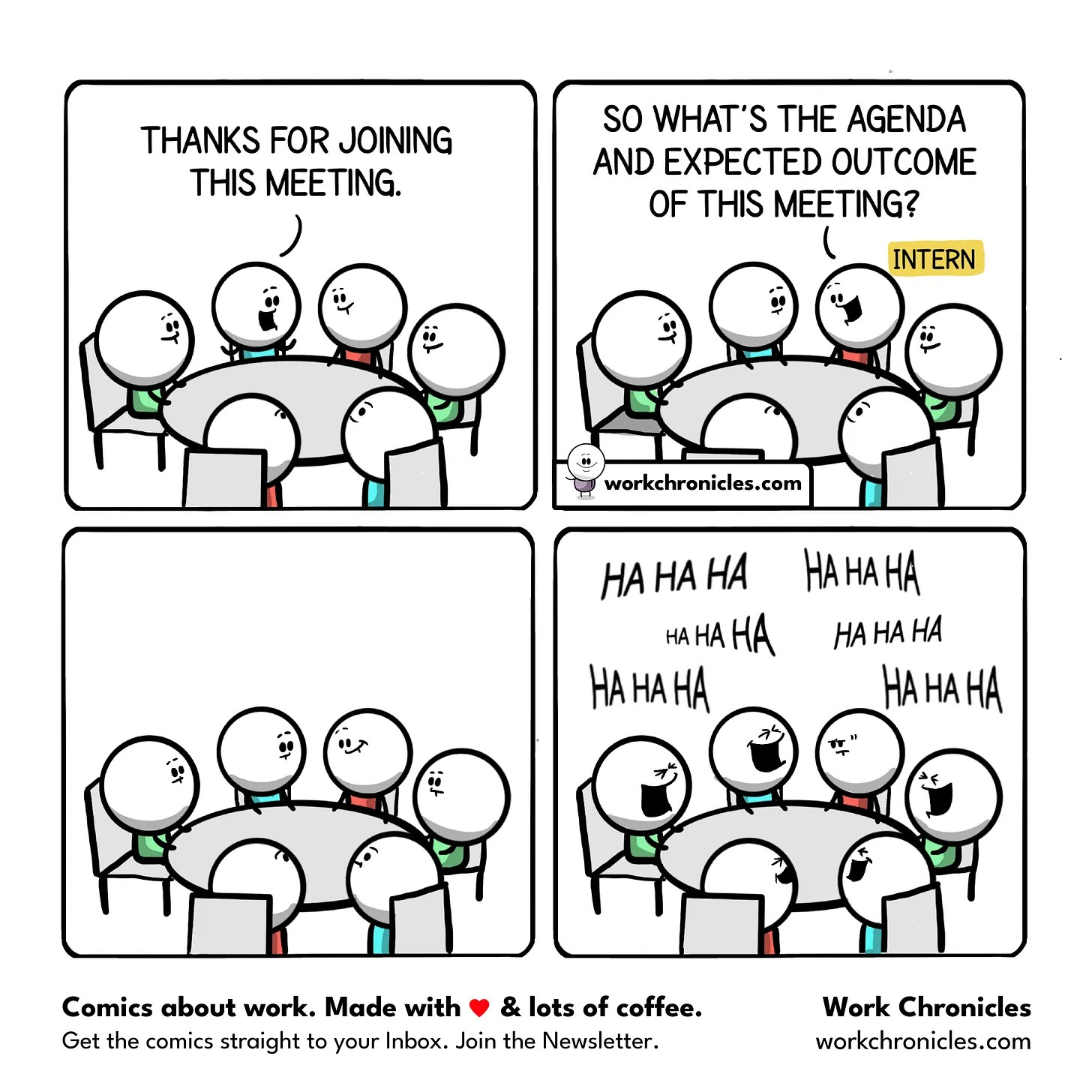
There are plenty of memes about getting nothing done because you spend the whole day in meetings.
Someone wrote the minutes by hand. Nobody read them.
The minutes said: "Let's do this, and we'll see how."
In Nerdflix, only the relevant people must show up.
You check each attendee's career profile to confirm they can make the decision.
/meeting-profiles: decides who needs to attend. 🧩
The AI and the company brain support them.
You record and transcribe the meeting.
The transcript isn't literal.
With a template, you keep only what matters.
If you spend five minutes talking about football, the minutes skip it.
The AI writes down the minutes and the action items: who said what, what to do, and how you track it.
An architecture decision becomes an architecture decision record (ADR) directly.
/meeting-minutes: writes the transcript, the minutes, and the action items. 🧩
Scheduling happens automatically.
/find-timeslot: books the meeting automatically. 🧩
⚠️ Consent: You tell people when you record them.
🧭 Human in the loop: A person reviews the minutes before publishing them. Otherwise, someone could say "the AI wrote that action item". No. You did.
Managing Up and Stakeholders
In Nerdbuster, managing up meant guessing.
You guessed what your boss wanted to hear, and you showed up with the answer before they asked the question.
The result was a long, detailed report and a weekend lost to bureaucracy.
In Nerdflix, the AI translates the technical status into business impact.
One page. No jargon.
/executive-summary: fits the status on one page. 🧩
The AI is your sparring partner.
You use it in adversarial mode: "I have to say this, and a business person will sit in front of me."
The AI tells you if your tone and language fit that audience.
You can ask it to play an aggressive customer who pressures you commercially.
You train with AI sparring, and you walk in with your answers ready.
(I wish I had this when I started managing).
Managing up is no longer guessing.
It's communicating well and fast, in the language of the person who decides.
/translate-to-business-language: turns technical status into business impact. 🧩
🧭 Human in the loop: Reviewing your commitments is critical. The AI can't promise on your behalf.
Communications, Auto-Replies, and Alerts
In Nerdbuster, you wrote to a customer on long email.
You copied half the company, just in case.
The longer it was, the more serious it looked.
Email chains grew out of control. "RE: RE: RE:" until you lost count.

Photo by Antoni Shkraba from Pexels
Nobody tracked them, and nobody knew who should answer.
At some point, the thread faded away. Until someone brought it back.
There were no clear action items, but plenty of people in copy, each one hoarding the thread.
In Nerdflix, you write much shorter messages. Straight to the point.
/summarize-status: summarizes where each thread stands. 🧩
And there's something new: you don't know if a person or an AI agent reads your message on the other side.
You write differently, knowing that.
/adversarial-customer-role: plays a tough customer so you test your message before you send it. 🧩
The AI is your friend and also your foe.
😈 Inbox zero.
Your inbox isn't a to-do list.
You process everything that comes in: with a rule, with the company brain, with your attention, or with an AI agent.
You work with empty backlogs.
The AI summarizes and prioritizes the threads and the alerts, and drafts the replies.
For routine messages, you can use an agent like OpenClaw or Hermes.
/triage-inbox: sorts and prioritizes your inbox. 🧩
🧭 Human in the loop: Every message carries your signature and your tone, not the plastic AI tone.
⚠️ Governance: Turning on auto-replies and reading confidential information is never your decision alone. It needs explicit approval from your organization governance and the least privilege possible. That makes it a governance decision. These agents aren't approved products in most companies. You should never upload confidential data to an AI your company hasn't approved. It can leak.
🧭 Human in the loop: The manager decides what gets automated and what doesn't.
Delegating
In Nerdbuster, delegating meant handing out tickets at the planning meeting.
You assigned them to whoever was available.
Or to whoever had fewer sticky notes on the whiteboard.
People were treated as interchangeable, fungible resources.
"I had a programmer. Another programmer arrived. Same thing."
You know people aren't the same and you should treat them kindly and individually. You should ban the word resource from your Taylorist language.
In Nerdflix, delegating well is something else.
You shouldn't say "you have to do this task".
You say: "This is for a critical customer. It goes to production in a week. We're late. Something else comes after it."
You explain the why to the AI. You explain it to people too.
You drop the Taylorist "do this as requested, never mind why".
Context empowers people. With enough autonomy, they take responsibility.
The context comes from the company brain.
/delegate-with-context: pulls the context from the company brain and structures the delegation. 🧩
The team takes ownership, with autonomy.
Open your AI model and type:
I need to organize the next Nerdflix sprint.
That's a mediocre prompt.
It's vague. It has no context and no constraints. It hands the whole decision over to the AI.
Now try something different:
ROLE: Act as the Engineering Manager of an 8-person team on Nerdflix.

CONTEXT:
We have 12 pending tickets.
Three of them impact customers.
Two of them block other work.
We have an external dependency that will probably arrive late.
The team is showing signs of burnout.
The project deadline can't move.

TASK: Help me decide what should go into the next sprint.

CONSTRAINT: Don't make the decision for me.
First, identify the relevant variables.
Then propose three different strategies.

OUTPUT: For each strategy, explain:
- What we gain
- What we sacrifice
- What risk we introduce
- What additional information we would need

Finally, challenge my decision.
Act as a manager who disagrees with me.
You didn't ask it to write a sprint.
You asked it to help you think.
That difference is huge.
If you don't want to build a skill, you should at least write structured prompts.
You don't carry that context in your head.
It comes from the company brain: the accumulated memory of decisions, post-mortems, and incidents.
It doesn't appear by magic. You build it, session after session.
The better you build it, the better you delegate, because you give both the AI and the human the why and not just the what.
🧭 Human in the loop: The manager decides what goes into the sprint.
Post-Mortems
In Nerdbuster, the post-mortem was a tense meeting.
Everybody looked for a scapegoat. 🐐 The winner was usually whoever missed the meeting.

Photo by Yan Krukau from Pexels
The informal notes got lost. Nobody left with clear action items.
That was a culture of fear.
In Nerdflix, the post-mortem is blameless.
You learn from the process and improve it.
The AI transcribes the ceremony and extracts concrete action items.
You cut any blaming live.
The action items belong to the team, not to people.
If a person needs to adjust something, you handle it in private, with journaling.
Good and bad cases feed the company brain.
/post-mortem-minutes: transcribes the ceremony and extracts the action items. 🧩
🧭 Human in the loop: The facilitator cuts the blaming and rephrases it in generic terms, so nothing points at a person. A person reviews each case before it goes into the company brain.
Ceremonies: Stand-Ups, Retros, and Other Rituals
In Nerdbuster, the stand-up was literally standing up for thirty minutes.
It ended up as a status and time report.
Someone spent ten minutes explaining they had met with another team the day before. Everybody else was bored.
The retrospective was a wall of generic sticky notes: "what went well, what went wrong", with no real actions.

Photo by Mikhail Nilov from Pexels
In Nerdflix, the stand-up meeting is async.
Everybody writes. The AI builds the summary and flags real blockers.
You don't care what each person is doing.
You care about what's blocking them.
/standup-summary: summarizes the async stand-up and flags blockers. 🧩
Unblocking people is your job. Honestly, it's your only job.
A bit of informal chat is fine. You're human.
But if an update brings no action item and no blocker, nobody needs to hear it.
The AI also finds patterns across retrospectives.
It tells you, anonymously: "The last six meeting minutes mention that another team doesn't collaborate."
You don't need to ask. It detects the pattern. That's the agentic side of AI.
If a complaint repeats three times, it's a pattern, and you write it down so it never repeats again.
/retro-patterns: groups repeated complaints across sprints, not just the last one. 🧩
🧭 Human in the loop: The AI groups. The team decides what action to take.
The Talent Journey
In Nerdbuster, teams were rigid.
Job requisitions came with fixed profiles, based on effort estimations.
"We need a junior Java programmer." That was all you knew.
You interviewed with a written exam and an algorithm on the whiteboard. That tested memory, not judgment.
Dynamic programming questions that nobody, the interviewer included, ever used on the job.
Onboarding meant two months of theory before touching the code.
"Read these courses, mark them done, fill in the forms. Then we'll see."
Offboarding was an HR formality: a form, an email, and the knowledge walking out the door.
In Nerdflix, it's a single journey.
Teams are flexible and built around talent and timing.
You find which skills are missing and look for those profiles inside or outside the company.
You interview with a fluent conversation and an ambiguous scenario.
You tell the candidate up front: "You'll be recorded. The AI and I will evaluate you."
The AI takes the notes and evaluates tone and English proficiency.
The candidate uses AI for the technical part. You evaluate their judgment and how they supervise the AI.
/match-positions-to-skills: builds flexible teams based on talent. 🧩
New people are productive from day one.
The senior keeps the judgment calls.
When someone leaves, you audit agents, skills, and the company brain, not just the laptop.
/code-review,/spec-review,/process-evaluation: make new people productive from day one. 🧩
You also guide the newcomer with a flexible journey:
/junior-mentor: supports juniors while the senior keeps the judgment calls. 🧩
Letting someone go is also part of the journey:
/offboarding-audit: revokes access to agents, skills, and the company brain. 🧩
⚠️ Bias: You supervise the AI for bias in every hiring step.
⚠️ Law: You get advice on your local labor laws.
🧭 Human in the loop: The team decides who gets hired, not a score. Onboarding includes mentoring and review.
Team Health and Individual Feedback
In Nerdbuster, you detected overload when deliveries were already failing. Too late.
Burnout management was reactive and based on gut feeling.
Feedback happened once a year, in a performance review tied to the bonus.
You used the feedback sandwich 🥪 and other recipes.
In Nerdflix, aggregated team patterns, like working hours and commits, suggest a conversation.
Never the detail of a single person.
The AI warns you: "Commits are consistently happening outside working hours."
You don't surveil anyone. You spot a burnout pattern.
You also read patterns in the ceremonies and in one-on-ones with AI transcripts.
Feedback is constant, in small doses.
The AI captures situational notes, so you avoid recency bias in the performance review.
/one-on-ones: prepares and records your one-on-ones. 🧩
A review that looks only at the last month is always unfair.
With notes, you can say: "In March, this didn't go well. Two months later, I saw you learned it."
It shows people that you pay attention.
You take the notes when things happen. Looking back, the traces are hard to find.
/journaling: takes notes in every meeting. 🧩
⚠️ Team signal, not individual surveillance: You look at team patterns, never at one person's activity.
⚠️ Consent: Transcribing or recording always requires consent.
🧭 Human in the loop: The manager gives the feedback. The AI detects signals. It doesn't diagnose people.
AI as a Sparring Partner for Difficult Conversations
In Nerdbuster, you rehearsed for five minutes in the hallway, or you just walked in.
You imagined the other person's reaction by projecting your own logic.
The difficult conversation was a Taylorist asymmetry: you informed, you didn't talk.
In Nerdflix, you practice with the AI in two directions.
First, the AI plays the difficult counterpart, so you rehearse your answers before the real conversation. It shows you where the person may get defensive.
Then, "Act as...": the AI becomes that person, so you understand their logic before you talk to them.
Regular one-on-ones use open questions, always practiced with the AI first.
You lean on the AI to think before you act.
Like this talk, actually.
🧭 Human in the loop: What to say and how to act is the person's decision.
Professional Development: Evaluate, Correct, Plan
In Nerdbuster, the evaluation was a generic form, unrelated to the actual role.
The improvement plan was an HR formality, the last step before firing someone, with no follow-up.
The career plan was arbitrary. Seniority or performance?
In Nerdflix, it's a single flow.
You evaluate against a competency specification by role and seniority, with evidence: pull requests, incidents, design decisions, and one-on-one notes.
"You're here. The next step needs you there. This is the gap."
/compare-competencies: compares the evidence against the role specification. 🧩
You don't talk in abstract terms like "work on your autonomy".
You point to the specific case where autonomy was missing.
The process improvement plan comes directly from the review gap. It's real support.
The career plan maps possible transitions against the missing competencies.
/weekly-check-ins: follows the improvement plan week by week. 🧩
Promotions are also part of the people journey:
/promotion-gap: maps career transitions against the missing competencies. 🧩
🧭 Human in the loop: The manager runs the evaluation and the conversation. Extending, closing, or ending an improvement plan is decided together with Talent. The manager builds the career plan together with the person.
Salaries
In Nerdbuster, salaries were an arbitrary one-on-one negotiation.
How much you asked. How much the company dared to offer. How well you negotiated.
No market data.
Hallway gossip about who earns what was the closest thing to a salary survey.
Salary inequity, naturally.
In Nerdflix, you look at the sysarmy salary survey.
You compare the profile against a real market sample.
You calibrate. You don't guess.
/calibrate-role: calibrates the salary band for the role. 🧩
You do it all the time, because the market moves.
You might learn someone is unhappy this month because the market pays more.
/salary-benchmark: compares the profile against the market. 🧩
🧭 Human in the loop: The company makes the final call on the salary band, with the manager's calibration.
Other People Topics
I left out other big topics on the people side:
- AI usage governance
- Remote team rituals and culture
- Diversity and inclusion
- Peer conflicts
- Wellness
- Peer mentoring and coaching
- Budget and contractor or vendor management
Please write new topic ideas for a third article in the comments.
The Manager's Territory
Managers added value by coordinating people.
With five, ten, or twenty people, the problem was always the same: you couldn't be everywhere.
Meetings, reports, dashboards, and objectives and key results (OKRs) all solved the same problem.
The real limitation was always the manager's cognitive capacity.
Now there's a machine that reads, summarizes, compares, and challenges decisions.
That goes beyond automating administrative tasks.
It's entering the manager's territory.
Human judgment is the most important thing.
That's why they hire you.
The AI doesn't have human judgment.
For now.
Automate, Operate, Augment
There are three levels of AI use:
- Automate: the AI does a task on its own.
- Operate: the AI runs a workflow or a sequence of tasks.
- Augment: the AI dramatically improves your ability to decide.

Image by boundsmarnie from Pixabay
This article is mostly about the third level.
That level separates the chatbot that summarizes your email from the AI that challenges your management decisions.
You shouldn't stay at the first or second level. You need to be augmented.
People ask me where to download my skills.
You can't. You build your own. They're personal.
You start by asking the AI: "Create a skill for me." Then you use it, refine it, and let it mature.
You build all these 🧩 skills by interacting with the AI, and you script the repeatable steps.
You can take these three concepts back to work.
Nobody Taught You
Managers aren't early adopters.
But you're as replaceable as any other role.
I didn't show you any specific tool.
This isn't theory. You can apply it right now.
I'd rather leave you with the itch.
You keep hearing that "AI won't replace you".
That's true.
But a manager who uses it well will.
It's not your fault. Nobody taught you.
Not your university, not your company, not YouTube.
Today, that changes.
About the author
I’m a senior software engineer loving clean code, and declarative designs. S.O.L.I.D. and agile methodologies fan.
Comments
Join the discussionNo comments yet. Be the first to comment.
Artificial Intelligence
This series include articles related to - Machine Learning - General Artificial Intelligence - Centaurus Coding - Tools like GPT-3, Codex, Copilot